Are Countertop Dishwashers Any Good?
Yes, countertop dishwashers are good enough for most small households. They wash 2 to 3 place settings well, fit on a counter with no plumbing work, and cost far less than a built-in. They stop making sense when your sink has a pull-down sprayer or your load includes big pots and pans.
On this page (9 sections)
- Are countertop dishwashers any good at actually cleaning dishes?
- How much can you fit in a countertop dishwasher?
- Do you need special plumbing for a countertop dishwasher?
- Is a countertop dishwasher right for your household?
- Which countertop dishwasher should you start with?
- Which detergent works in a small dishwasher?
- How do countertop dishwashers compare on running costs?
- What are the real drawbacks of countertop dishwashers?
- So, are countertop dishwashers worth it?
Yes, countertop dishwashers are good enough for most small households. They wash 2 to 3 place settings well, fit on a counter with no plumbing work, and cost far less than a built-in.
They stop making sense when your sink has a pull-down sprayer or your load includes big pots and pans.
The question really splits into two: does a countertop machine clean dishes as well as a full-size one, and does its size and hookup fit your kitchen? The short answer is that cleaning performance holds up well, while capacity and faucet fit are where buyers get caught out.
Our guide to countertop vs built in dishwasher covers the trade-offs in more detail.
Are countertop dishwashers any good at actually cleaning dishes?
Yes. A countertop dishwasher cleans everyday dishes as well as a full-size machine, because it uses the same wash arms, detergent and hot water.
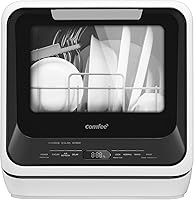
The COMFEE' 6-place model sprays from 12 nozzles in a 360° spiral pattern and reaches temperatures up to 154°F on its Heavy cycle.
That combination is what lifts grease and dried-on food. The Heavy program pairs high water pressure with the hot spray, so a plate left overnight usually comes out clean without pre-rinsing.
The Baby-Care and Glass cycles turn down the heat so delicate items don't cloud or crack.
What changes with the size is how the water reaches the dishes. A narrow countertop tub holds fewer items, so there is less chance of a plate blocking the spray.
Many people find a small machine cleans better per load than a crammed full-size rack.
The catch is loading. You can't toss in a roasting pan and let the machine handle it.
Stacking matters more, and bowls need to face the spray. If you load sensibly, the results are good.
How much can you fit in a countertop dishwasher?
A countertop dishwasher holds about 30 items, or 6 place settings on the largest models, enough for 2 to 3 people. Plates up to 10 inches wide fit, along with cups, glasses and cutlery.
The COMFEE' 6-place model measures 17.2 in high by 21.7 in wide by 19.7 in deep and takes up to 70 pieces of tableware. That's a real dinner's worth of plates, bowls and mugs for a couple or a small family.
A 2-place setting machine is tighter and suits one person.
Space at the top matters as much as the floor plan. The COMFEE' tank model needs more than 19.6 inches between the counter and the wall cupboard to fit and open.
Measure that gap before you order anything.
Large cookware is the hard limit. Stockpots, sheet pans and tall pasta pots don't fit, so anyone who cooks big meals will still hand wash.
That's the honest reason some kitchens outgrow a countertop machine.
Do you need special plumbing for a countertop dishwasher?
No. Most countertop dishwashers connect to the kitchen faucet, so you need no plumber and no cabinet cut-out.
The COMFEE' 6-place model connects straight to the tap with a supplied adapter and drains into the sink.
The setup is simple. You unscrew the faucet aerator, screw on the adapter, and attach the inlet hose.
The drain hose hooks over the sink edge. When the cycle ends, you unhook and store the hoses.
The one real blocker is faucet type. A pull-down or pull-out sprayer head usually can't take the adapter, and some designer taps don't either.
Check your faucet before buying, because this is the most common reason a return happens.
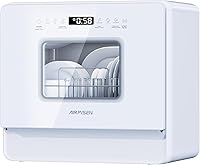
The COMFEE' tank model sidesteps the issue. It has a 5L built-in water tank, so you fill it by hand and never touch the plumbing.
That makes it the practical choice for renters or anyone with an awkward tap.
Is a countertop dishwasher right for your household?
It's right for 1 to 3 people, small kitchens, dorms and RVs. It's wrong for a family of 4 or more who cook daily and generate pots and pans with every meal.
Our how to choose a countertop dishwasher guide walks through the fit questions in order.
Count your daily load first. If you fill a drying rack most evenings with plates, mugs and a few bowls, a 6-place machine will keep up.
If a typical evening adds a stockpot and a sheet pan, you'll still be at the sink.
Think about where it will live. The machine needs counter space near the sink and, for a faucet model, a free tap for the length of the cycle.
A tank model needs only an outlet, so it can sit farther away.
Also weigh the noise. The COMFEE' 6-place model runs at 52 db, which is quiet enough to talk over, but it still runs 45 minutes on Speed and longer on Heavy.
Plan cycles around meals rather than during them.
Which countertop dishwasher should you start with?
Start with the COMFEE' 6-place model if you have a standard faucet and 2 to 3 people to wash for. It offers the most capacity and the most cycles in this group, and its Energy Star rating keeps water use low at as little as 2.77 gallons per cycle.
The Speed cycle finishes in 45 minutes, which suits a quick wash before guests arrive. The extra-drying function helps on the Glass and Baby-Care cycles.
It also fits under a cupboard if counter space is tight.
Choose the COMFEE' Countertop Dishwasher With 5L Tank instead if your faucet won't take an adapter or you rent. It holds 30+ items and runs six programs, including Steam and Fruit, without any hose connection.
The trade is that you fill the tank by hand each time.
Which detergent works in a small dishwasher?
Use a powder or tablet made for dishwashers, not liquid dish soap. Cascade Complete Powder is phosphate-free and built to clean 24-hour stuck-on food and baked-on residue without pre-washing.
That matters in a small tub, where there is less water to dilute a weak detergent. The powder also handles tea stains, which show up quickly on glassware in a compact machine.
It's safe on all dishwasher-safe dishes.
Liquid dish soap is the one thing to avoid. It foams up in a closed tub and can leak out of the door.
Keep a separate bottle of hand soap by the sink so nobody grabs the wrong one.
For the tank model, COMFEE' says to use standard dishwasher powder or detergent. Its Fruit program needs no detergent at all, and the Rapid cycle takes about half the usual amount.
Following those amounts keeps suds down.
How do countertop dishwashers compare on running costs?
They're cheap to run. The COMFEE' 6-place model is Energy Star rated and uses about 174 kilowatt hours per year, based on its stated energy consumption.
Water use is as low as 2.77 gallons per cycle on its efficient settings.
Compare that with the sink. Washing a meal's dishes by hand in a full basin of hot water uses more water than one compact cycle, and the machine heats its own water to a higher temperature.
The savings add up over a year for a small household.
The tank model lists energy consumption at 0.35 kwh. It uses a third of the water of hand washing, according to COMFEE', which fits its no-hookup design.
Neither machine needs a hot water feed for every cycle, so the faucet stays free once the hose is off.
Electricity rates vary, so the real bill depends on your tariff and how often you run a cycle. Even so, a compact machine that fills one rack is a modest draw compared with a full-size dishwasher run half empty.
What are the real drawbacks of countertop dishwashers?
The drawbacks are capacity and placement, not cleaning. A countertop machine takes counter space, handles smaller loads, and can't wash large cookware.
Those limits are the honest trade for the easy install and low price.
Counter space is the first cost. The COMFEE' 6-place model is 21.7 inches wide, so it claims a real stretch of worktop.
Some people fit it under a cupboard to free the counter, but the clearance above still matters.
Load size is the second. Six place settings covers a couple or a small family, not a dinner party with serving dishes.
You'll run more cycles than a full-size owner would.
The third is faucet dependence. A faucet-connected model ties up the tap during the wash.
If you cook and clean at the same time, that gets awkward, which is where the tank model earns its place.
None of these are cleaning failures. They're fit questions, and they decide whether a countertop machine suits your kitchen more than any spec sheet can.
So, are countertop dishwashers worth it?
For the right household, yes. If you live alone or as a couple, rent, or have a small kitchen without room for a full-size machine, a countertop dishwasher is a genuinely useful appliance.
It washes a day's dishes in one compact cycle, uses less water than the sink, and connects to a faucet or a tank with no plumber.
The decision rule is simple. Pick a faucet-connected 6-place model like the COMFEE' if your tap takes an adapter and you want the most capacity per cycle.
Pick the tank model if your faucet won't cooperate or you want the machine away from the sink. If you regularly cook for 4 or more and generate pots and pans, save for a built-in instead.
If you're still deciding whether countertop dishwashers are any good for your home, start with your faucet and your daily plate count. Those two answers settle it faster than any feature list.
Frequently asked questions
Do countertop dishwashers need a plumber to install?
No. Most connect to a kitchen faucet with a hose and adapter, so you unscrew the aerator and screw the adapter on yourself.
The COMFEE' tank model skips the faucet entirely: you fill the 5L tank by hand and plug the machine into a normal outlet.
How many dishes fit in a countertop dishwasher?
Expect about 30 items, or up to 6 place settings on the larger COMFEE' model. That covers plates up to 10 inches wide, cups, glasses and cutlery for 2 to 3 people, but not stockpots, sheet pans or a full dinner party.
Does a countertop dishwasher use more water than washing by hand?
Usually less. The COMFEE' Energy Star model uses as little as 2.77 gallons per cycle, while running a sink of hot water for the same dishes can easily use more.
A full cycle also washes at temperatures up to 154°F, which hand washing rarely reaches.
Can a countertop dishwasher fit in an apartment without plumbing changes?
Yes, that's what they're built for. The COMFEE' 6-place model connects straight to the faucet and drains into the sink, so you undo the hose and store it when the wash is done.
The tank model needs only an outlet and a spot on the counter.
Are countertop dishwashers loud?
The COMFEE' 6-place model runs at 52 db, about the level of a quiet conversation. That's quieter than many full-size dishwashers.
It still runs for 45 minutes or more, so start a cycle when you leave the room or before bed.
What can't a countertop dishwasher wash?
It can't fit large pots, sheet pans or tall stockpots, and most models handle only 10-inch plates. Wooden boards, cast iron and anything hand-wash-only stay out too.
For those, plan on washing by hand or look at a built-in model.