Countertop vs Built-In Dishwasher: Which Is Better? (October 2026)
Choose a countertop dishwasher for a rental or small kitchen without a permanent installation; choose a built-in for more place settings and a fixed kitchen setup. The countertop dishwasher vs built-in choice depends on available space, plumbing and how many dishes you wash.
On this page (7 sections)
Choose a countertop dishwasher for a small kitchen, rental or flexible setup; choose a built-in when you have cabinet space and want more capacity. The countertop dishwasher vs built-in decision turns on your room, plumbing and typical dish load.
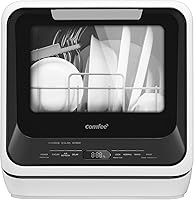
The COMFEE' countertop model holds 6 place settings and can connect to a faucet with a suitable adaptor. The COMFEE' built-in holds 8 place settings and needs a fixed installation.
A tank-fed countertop option can avoid a faucet connection during use. The EUHOMY has a 5 L tank, or you can connect its hose to a faucet.
 Best for faucet connection
COMFEE' Energy Star 6-Place Countertop Dishwasher

Countertop dishwasher vs built-in: which fits your kitchen?
A countertop dishwasher needs a clear counter or cupboard area; a built-in needs a suitable cabinet opening and planned connections. Measure the space and check the installation instructions before choosing either type.
The COMFEE' countertop measures 21.7 in wide, 19.7 in deep and 17.2 in high. The EUHOMY measures 16.73 in wide, 16.85 in deep and 18.03 in high.
The COMFEE' built-in is 17.6 in wide, 22.6 in deep and 32.4 in high, with adjustable legs. Its slim width can help where a standard-width dishwasher won't fit, but you still need a compatible cabinet opening and installation setup.
Countertop dimensions don't include extra room for hoses, the door opening or ventilation. Leave working space around the machine and follow the manual for clearances.
Will a countertop dishwasher fit under your cabinets?
A countertop model can be placed in a cupboard, but check the full setup rather than the closed machine alone. You need room to load the door, route the hoses and reach the controls.
The EUHOMY recommends more than 19 in of vertical clearance between the counter and upper cabinets. The COMFEE' is 17.2 in high, but confirm its placement and clearance guidance before putting it under a cabinet.
If your counter is crowded, consider whether a sturdy table or stand can hold the dishwasher safely. Check the support's weight rating against the machine and keep it level.
How do capacity and daily loads compare?
The built-in COMFEE' has 8 place settings, compared with 6 in the countertop COMFEE'. Choose by the load you create between wash cycles, not just the number of people in your home.
The COMFEE' countertop model is described as suitable for 2 to 3 people and can fit up to 70 pieces of tableware. It fits plates up to 10 in in diameter.
The EUHOMY is described as holding 30 or more items and fitting plates up to 10.25 in. Its rack layout includes a cutlery holder, fruit basket and storage rack.
Place settings don't translate into the same number of plates for every household. Pots, glasses and serving dishes take different amounts of room, so compare the rack layout with the items you use most.
For a closer look at the capacity term, see what 6 place settings mean in a countertop dishwasher. If you're deciding between countertop sizes, how to choose a countertop dishwasher covers fit and use.
Which type suits a one or two person household?
A countertop model may fit a smaller household if its racks hold the dishes you use each day. You can also run it more often when meal prep or guests create an extra load.
A built-in may suit a small household too if you prefer to collect dishes for a fuller load and have room for a permanent unit. Its extra place settings can be useful for cookware, but don't assume every pot will fit.
Think about your largest regular load. If you often cook with several pans, check usable rack space and plate height rather than relying on capacity labels alone.
How do setup and water supply differ?
A countertop dishwasher can use a faucet connection or, on some models, a built-in tank; a built-in requires fixed plumbing and installation. Check your faucet and drain arrangement before buying a countertop unit.
The COMFEE' countertop connects directly to a faucet with a suitable adaptor. Its accessories include an inlet hose, drain hose, faucet adapter and quick connect.
The EUHOMY offers a built-in 5 L tank or faucet supply through its included hose. Its faucet connection is compatible with G3/4-inch connections, and an adapter may need to be purchased separately.
A built-in dishwasher needs a cabinet opening and water, drain and electrical connections suited to the installation. Follow the manufacturer's manual or use a qualified installer if the connections aren't already in place.
For first-time setup, follow the model's manual for water supply, drainage and placement. Our guide to setting up a countertop dishwasher walks through that process.
What do you gain and give up with each type?
Countertop models offer flexible placement, while a built-in keeps the dishwasher in a fixed kitchen position and offers more capacity in this comparison. The right trade-off depends on the space you can give up.
Countertop dishwasher advantages and limits
A countertop unit can work in a rental or dorm where a built-in installation isn't available. The EUHOMY's tank can also provide water without a faucet connection during the wash.
The trade-off is counter or table space. A machine on the worktop can reduce room for food preparation, and its hoses need a sensible route to a faucet and drain when connected that way.
Moving the unit also takes planning. The COMFEE' countertop weighs 46 lb, while the EUHOMY weighs 28.6 lb, so consider the lift and support surface before choosing a location.
Built-in dishwasher advantages and limits
A built-in can keep the worktop clear and provide a larger place-setting capacity. The COMFEE' built-in holds 8 place settings and has an adjustable upper rack.
Its fixed installation makes it a poor fit if you can't modify the kitchen or lack the necessary connections. Measure the opening carefully, including depth and height, and follow the installation requirements.
A built-in is also less flexible if you move home or change the kitchen layout. Consider how long you expect to use that kitchen before investing in a permanent setup.
Which model fits each type of buyer?
Choose the COMFEE' countertop for a faucet-connected 6-place-setting option, the EUHOMY for a tank-fed countertop setup, or the COMFEE' built-in for 8 place settings and fixed installation. These products suit different kitchens and aren't interchangeable.
Our score weighs specs, features and buyer feedback against what you're shopping for.
For a wider overview of small models, start with countertop and tabletop dishwashers: what to know first. It explains the basic types and their setup needs.
Which dishwasher should you choose?
Pick a countertop dishwasher if you need flexible placement or can't install a built-in; pick a built-in if you have a suitable kitchen opening and want 8 place settings. Measure your space, check the connection plan and match capacity to your normal load.
Choose the EUHOMY if the 5 L tank option suits your kitchen and its footprint and clearance work. Choose the COMFEE' countertop if the 6 place settings and faucet connection fit your routine.
Choose the COMFEE' built-in when fixed installation is practical and you want its 8-place-setting capacity. For countertop choices, compare countertop dishwasher size and fit before deciding.
Sources
- COMFEE' 18-Inch Built-In Dishwasher
- ENERGY STAR: Dishwashers
Frequently asked questions
Is a countertop dishwasher as good as a built-in?
A countertop dishwasher can suit smaller loads and kitchens where a permanent installation isn't practical, while a built-in can hold more place settings. Cleaning results depend on the specific model, load and cycle, so compare the features and capacity of the units you're considering.
Does a countertop dishwasher need plumbing?
Some countertop models use a built-in water tank, while others connect to a faucet with a suitable adaptor. Check how the exact model drains and whether your faucet connection fits before you choose; a built-in dishwasher needs the planned water and drain connections for installation.
How many dishes fit in a countertop dishwasher?
Capacity varies by model. The COMFEE' countertop dishwasher has 6 place settings and is sized for up to 70 pieces of tableware, while the EUHOMY holds 30 or more items.
Check the rack layout and plate size against the dishes you use.
Can you put a countertop dishwasher under a cabinet?
Some countertop dishwashers can sit in a cupboard, but you need to check the model's dimensions, hose routing and operating clearances first. The COMFEE' measures 17.2 inches high, while EUHOMY recommends more than 19 inches of vertical clearance for its countertop model.
Which dishwasher is easier to move?
A countertop model is generally easier to relocate because it sits on a counter or table rather than being installed in cabinetry. Still, check the unit's weight and plan a safe lift; the COMFEE' countertop model weighs 46 pounds and the EUHOMY weighs 28.6 pounds.