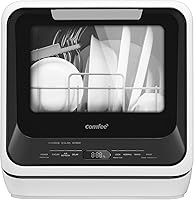
Countertop and Tabletop Dishwashers: What to Know First
A tabletop dishwasher is a compact machine for washing smaller loads on a counter or sturdy table. Choose a tank model for flexible placement or a faucet-connected model near a compatible tap, then confirm the machine, dishes, drain route and clearance all fit.
On this page (11 sections)
- What is a tabletop dishwasher?
- How does a countertop dishwasher get water?
- Will a tabletop dishwasher fit your kitchen?
- What size dishes fit inside?
- Which tabletop dishwasher features matter most?
- Which tabletop dishwasher fits your routine?
- Do tabletop dishwashers clean well?
- How should you set up and care for one?
- What common mistakes make small dishwashers harder to use?
- What should you check before buying?
- Which tabletop dishwasher should you choose?
A tabletop dishwasher, also called a countertop dishwasher, washes smaller loads without taking up floor space. It can suit an apartment, dorm, RV or small kitchen, but the right choice depends on your counter, dishes, water supply and drain route.
Some models connect to a faucet, while others have a built-in tank you fill by hand. Measure the spot and your largest dishes before comparing cycles or extra features.
If you’re weighing different compact models, our guide to choosing a countertop dishwasher explains the main trade-offs. For a larger change to your kitchen, compare countertop and built-in dishwashers.
What is a tabletop dishwasher?
A tabletop dishwasher is a freestanding appliance designed to sit above the floor, usually on a counter or sturdy table. “Countertop dishwasher” is the more common name for the same general type of compact machine.
It can add automatic dishwashing where a full-size unit will not fit or cannot be installed. Its smaller rack usually means you’ll run more frequent loads, and large pots or serving dishes may need to be washed by hand.
Check the machine’s dimensions, water supply and drain requirements instead of relying on its name. “Portable” does not necessarily mean you can use it anywhere without planning for a hose, outlet and safe place for wastewater.
Is a countertop dishwasher portable?
Many countertop dishwashers are freestanding and do not require permanent built-in installation. Portability still depends on the model’s weight, the connection setup and whether you have a suitable place to use it.
A tank model can avoid connecting the water inlet to a tap, but it still needs power and a way to drain. A faucet-connected model must be close enough to the sink, with a compatible tap and hose reach.
Read how to set up a countertop dishwasher before connecting one. Follow the manual’s placement, filling and drainage instructions.
How does a countertop dishwasher get water?
A countertop dishwasher gets water from a faucet connection or a built-in tank, depending on the model. A faucet connection suits a machine that stays near a compatible tap; a tank can give you more freedom to place it.
A tank avoids an inlet connection to the tap, but you still need a drain point and power outlet nearby. A faucet-connected model needs a compatible adapter, enough hose reach and access to the faucet while it runs.
| Water supply | What it means | Check before choosing |
|---|---|---|
| Built-in tank | You add water by hand | Tank size, filling steps and drain route |
| Faucet connection | The dishwasher draws water through a hose | Adapter compatibility, hose reach and tap access |
Do not assume every faucet works with every adapter. Check the manual’s connection requirements, especially if your tap has a pull-down sprayer or an unusual outlet.
Tank filling also adds a step to every cycle. Think about where you will keep the filling pitcher, whether you can reach the tank comfortably and how you will know when it is full.
Will a tabletop dishwasher fit your kitchen?
A tabletop dishwasher fits when the surface can support it, nearby cabinets leave enough clearance, and you can route the hoses and power cord safely. Measure the complete space before choosing a model.
Measure width, depth and height, including the room needed to open the door and load dishes. The COMFEE' Mini Countertop Dishwasher With 1.32 Gal Tank specifies more than 19.6 inches between the counter and wall cupboard.
The COMFEE' Energy Star 6-Place Countertop Dishwasher measures 21.7 inches wide, 19.7 inches deep and 17.2 inches high. The COMFEE' Mini Countertop Dishwasher With 1.32 Gal Tank measures 16.53 inches wide, 17.13 inches deep and 17.24 inches high, with the specified overhead clearance.
Check the surface’s weight rating as well as its dimensions. A narrow table may fit the machine’s footprint but still be unstable, especially when hoses pull against it or the door opens.
Remember to account for nearby tasks. A dishwasher that blocks your main food-prep area, a cabinet door or access to the sink can make a small kitchen harder to use.
What size dishes fit inside?
The useful capacity is the number of dishes you can load while leaving water room to reach them. Check your largest plates, bowls, cups and utensils against the rack and the stated limits.
The COMFEE' Energy Star 6-Place Countertop Dishwasher holds up to 6 place settings and plates up to 10 inches in diameter. The COMFEE' Mini Countertop Dishwasher With 1.32 Gal Tank holds 30 or more items and plates up to 9.5 inches.
Those limits do not mean every mix of dishes will fit at once. Rack shape, bowl depth, handles and the way you load each piece all affect usable space.
Count a typical meal’s dishes rather than imagining an ideal load. If you regularly use wide dinner plates, tall travel cups or long utensils, check that each can sit in the rack without blocking the spray arms.
For a plain explanation of capacity labels, read what 6 place settings mean in a countertop dishwasher. If you plan to load cookware, see whether a countertop dishwasher can wash pots and pans.
Which tabletop dishwasher features matter most?
The best features depend on your kitchen and the dishes you wash most. Start with setup and usable capacity, then consider cycles, drying options and water treatment.
Which tabletop dishwasher water setup suits you?
A built-in tank suits kitchens where you do not want to connect the dishwasher to a faucet. The COMFEE' Mini Countertop Dishwasher With 1.32 Gal Tank and HAVA Countertop Dishwasher With Water Softener each have a 5 L tank; the COMFEE' Mini can also connect to a faucet.
A faucet-connected model can be convenient if it will stay beside the sink. The COMFEE' Energy Star 6-Place Countertop Dishwasher and Midea Energy Star Countertop Dishwasher connect to a faucet with a suitable adapter.
Think about how often you will use the appliance. If you expect several loads a day, manual filling may become a chore.
A faucet-connected model may be inconvenient if a hose would cross a busy work area or your tap cannot accept the adapter.
How much capacity should a tabletop dishwasher have?
Choose capacity around the dishes you use, not just the number of people in your home. A 6-place-setting machine can handle more tableware per load, while a smaller interior may be easier to fit but call for more frequent cycles.
Consider how much counter space you are willing to give up. The larger machine may reduce the number of loads, but only if its rack fits your dishes and its footprint works in your kitchen.
If you cook with large pots or bakeware, verify their dimensions before expecting them to fit. Compact racks are often best for plates, bowls, cups and cutlery rather than bulky cookware.
Which wash and drying programs are useful?
Program names and counts vary, so focus on the cycles that match your routine. The models here include options such as normal, rapid, glass, hygiene or baby-care cycles; some also offer an extra-drying function.
A shorter cycle can help when you need dishes sooner, but match the program to the load and soil. A glass cycle, for example, is meant for a different load than a heavy or hygiene cycle.
Drying functions can help reduce moisture after washing. Check how the manual says to use them and whether the function can be turned off when you do not need it.
Should hard water affect your choice?
Hard water can leave mineral deposits in a dishwasher and marks on dishes. The HAVA Countertop Dishwasher With Water Softener includes a softener setting based on water hardness.
If you already see scale around taps or on glassware, water treatment may be a useful feature to compare. Check the manual for the required setup and care, since a softener needs to be configured and maintained as directed.
For broader care advice, see our guides to hard water dishwasher problems and choosing detergent for hard water.
Which tabletop dishwasher fits your routine?
The COMFEE' Energy Star 6-Place Countertop Dishwasher is the best fit here for households that want a larger rack and a faucet connection. Skip it if its footprint or the need for a compatible tap does not work in your kitchen.
It measures 21.7 inches wide and holds up to 70 pieces of tableware. It uses as little as 2.77 gallons of water per cycle and includes a 45-minute Speed program.
The COMFEE' Mini Countertop Dishwasher With 1.32 Gal Tank suits renters, dorm residents and other users who need flexible placement. Skip it if you regularly use plates wider than 9.5 inches or want a quieter machine.
You can fill it by hand or connect it to a kitchen faucet with the included hose and adapter. It holds 30 or more items and has a Rapid program and Air Refresh drying mode.
The HAVA Countertop Dishwasher With Water Softener suits people who want a tank model with built-in water treatment. Skip it if you do not need a softener or prefer a simpler setup with fewer features to configure.
Its outside dimensions are 16.86 inches deep, 16.75 inches wide and 18.05 inches high. It also has a child lock and delayed start option.
The Midea Energy Star Countertop Dishwasher suits households that want a 6-place-setting capacity and a faucet connection. Skip it if your counter cannot fit its 22-inch width or you need a built-in tank for placement away from the sink.
It holds up to 70 pieces of tableware, with space for plates up to 10 inches. The machine uses 2.77 gallons of water and has a 52 dB noise specification.
Do tabletop dishwashers clean well?
A tabletop dishwasher can clean everyday dishes when they fit inside and you load them so water can reach their surfaces. Results depend on the cycle, detergent, soil level and loading.
Scrape off large food pieces before loading. Leave space between dishes, angle bowls and cups so water can drain, and avoid placing a plate where it blocks the spray arms.
Use automatic dishwasher detergent, not hand dish soap. Too much suds can cause problems, and detergent amounts may vary by cycle, so follow the manual.
If dishes come out with residue, check the load arrangement, detergent and filter care steps before assuming the machine has failed. Our guide explains whether countertop dishwashers clean well.
How should you set up and care for one?
Set up the dishwasher on a level, stable surface near the required water, drain and power connections. Keep hoses accessible and arrange them as the manual directs before running a cycle.
For a faucet-connected unit, confirm the adapter fits and the hose does not pull on the tap. For a tank model, follow the fill guide and make sure you can reach the tank without lifting water over electrical controls.
Route the drain hose to the approved drain point and avoid kinks. Keep the cord and plug away from water, and do not block controls or any ventilation openings.
After use, leave the interior to dry as directed by the manual. Wipe spills, clean the filter and remove food debris at the intervals the manufacturer recommends.
Use detergent designed for automatic dishwashers. Do not use hand dish soap, and check the manual before adding rinse aid, salt or other dishwasher products.
If your home has hard water, pay attention to mineral buildup and follow the appliance’s water treatment instructions. Our guide to cleaning a countertop dishwasher covers routine upkeep.
What common mistakes make small dishwashers harder to use?
The most common mistakes are buying before measuring, overloading the rack, choosing the wrong water setup and using the wrong detergent. Each can make a compact machine frustrating even when it fits the counter.
- Measuring only the machine: Include overhead clearance, door swing, hose space and a practical loading area.
- Assuming every faucet fits: Check the adapter requirements and tap shape before ordering.
- Choosing by place settings alone: Compare your largest dishes and the rack layout, not just the capacity label.
- Packing dishes tightly: Crowding can block spray and prevent water from reaching surfaces.
- Using hand dish soap: Use automatic dishwasher detergent to avoid excess suds.
- Forgetting the drain route: A tank removes the inlet connection, not the need to discharge wastewater.
- Ignoring daily effort: Manual filling may be fine for occasional loads but tedious when used often.
A quick footprint check helps expose several problems at once. Mark the machine’s width and depth with tape, then consider where the hoses go and whether you can still use the counter comfortably.
What should you check before buying?
Before buying a tabletop dishwasher, confirm that it fits your space, accepts your dishes and works with your water and drain setup. These checks matter more than a long list of programs.
- Measure the available width, depth and height, including overhead clearance.
- Check the largest plate and cookware you want to load.
- Decide whether you want to fill a tank or connect to a faucet.
- Confirm the hose can reach the drain point without crossing a walkway or kinking.
- Check the machine’s weight against the surface rating.
- Review the manual for clearance, electrical and connection requirements.
- Consider how often you will use it and how much counter space it will take each day.
A unit can fit on the counter yet block cabinet doors, the sink or your main work area. Test the footprint with tape and imagine filling, loading and unloading it.
If your model develops an issue, start with the manual and manufacturer support. Our countertop dishwasher troubleshooting guide covers common problems.
Which tabletop dishwasher should you choose?
Choose the COMFEE' Energy Star 6-Place model if you want a larger rack and have a suitable faucet nearby. Choose the COMFEE' Mini if flexibility and compact dimensions matter more than plate size.
Pick the HAVA if you want a tank model with a water softener, and choose the Midea if you want a 6-place-setting machine with a faucet connection. Skip countertop models altogether if your counter, drain route or daily dish load makes the trade-off impractical.
For more choices across sizes and setups, compare our best countertop dishwashers. Measure first, then choose the tabletop dishwasher that fits your kitchen and your routine.
Frequently asked questions
Is a tabletop dishwasher the same as a countertop dishwasher?
Usually, yes. Both names describe a compact dishwasher designed to sit on a counter or table, though setup and capacity vary by model.
Some connect to a faucet, while others draw water from a built-in tank.
Check the dimensions, water supply method and drain setup before choosing.
Do countertop dishwashers need plumbing?
Not always. Some countertop models have a built-in tank that you fill by hand, while others connect to a kitchen faucet with a suitable adapter.
Both types need a way to drain wastewater, so check the manual and make sure the sink or approved drain point is within reach.
How many dishes fit in a countertop dishwasher?
Capacity varies by model and by the size and shape of your dishes. Some larger countertop units hold 6 place settings and plates up to 10 inches, while a smaller tank model may fit 30 or more items and plates up to 9.5 inches.
Check rack dimensions and your largest dishes.
Can a countertop dishwasher sit on any table?
Use a level, stable surface that can support the filled machine. Check the manual for placement and clearance rules, then compare the dishwasher's weight with the surface rating.
Keep the drain hose routed as instructed and avoid blocking ventilation or controls.
Can I use regular dish soap in a countertop dishwasher?
No. Regular hand dish soap can create excess suds and cause problems in a dishwasher.
Use detergent made for automatic dishwashers, following the model's manual for the correct type and amount.
See our guide to homemade detergent in a countertop dishwasher for what to consider.