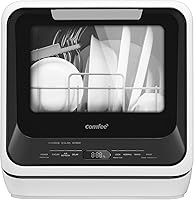
How to Choose a Countertop Dishwasher
To choose a countertop dishwasher, match its capacity and water supply to your routine, then confirm the space, clearance and drain route. Measure your counter and decide whether tank filling, a faucet connection or both will work.
On this page (8 sections)
- How do you choose a countertop dishwasher that fits?
- Should you choose a tank, faucet hookup or both?
- Which wash programs do you actually need?
- How should you compare drying, noise and water use?
- Which countertop dishwasher matches your kitchen?
- How do you set up and use a countertop dishwasher?
- What mistakes should you avoid before buying?
- How do you choose a countertop dishwasher for your routine?
To learn how to choose a countertop dishwasher, start by matching its capacity and water supply to your routine. Then check its dimensions, upper clearance, drain route and outlet so you know it will work in your kitchen.
A compact tank model can fit a tight space and avoid a faucet connection. A larger machine may handle more dishes per load, but it needs more counter space.
Use the checks below to narrow your choices before comparing cycles and drying features.
For an overview of the category, see what to know about countertop and tabletop dishwashers. If you’re deciding whether this format suits your kitchen, compare it with a built-in dishwasher.
How do you choose a countertop dishwasher that fits?
Choose a dishwasher that fits the usable counter space and the load you wash most often. Check the full outside dimensions and required clearance before weighing extra programs or drying features.
Measure the counter’s usable width and depth, including space for the door to open and the racks to slide out. Also leave room for loading and unloading, the water connection and the drain hose.
Next, measure from the counter to the bottom of the upper cabinet. Clearance guidance varies by model, so check the requirement for the machine you’re considering.
| Model | Outside size (W x D x H) | Clearance guidance |
|---|---|---|
| COMFEE' Mini | 16.53 x 17.13 x 17.24 in | More than 19.6 in above counter |
| COMFEE' Energy Star 6-Place | 21.7 x 19.7 x 17.2 in | Check the manual for placement requirements |
| EUHOMY 6-Program | 16.73 x 16.85 x 18.03 in | More than 19 in above counter |
| Hermitlux 7-Program | 16.85 x 16.73 x 18.23 in | At least 20.08 in above counter |
A machine can fit on the counter yet still be awkward if its hose cannot reach the faucet or sink. Plan the water and drain routes before you settle on a location.
If counter space is tight, compare compact footprints first. The countertop and tabletop dishwasher guide explains what to check across the common formats.
How do you choose a countertop dishwasher by size?
Choose capacity based on what you want to wash between loads, not just the number of people in your home. Place settings and item counts are useful starting points, but the shape of your dishes affects what fits.
The COMFEE' Mini is described as holding 30+ items, with plates up to 9.5 in. EUHOMY also holds 30+ items and fits plates up to 10.25 in.
Hermitlux fits 5 place settings, with 10.25 in plates loaded at an angle. The COMFEE' Energy Star model is described as a 6-place-setting machine that can hold up to 70 pieces of tableware.
Think about your largest regular load, including bowls, cups and cutlery. If you often wash cookware, check whether it fits around those items instead of assuming a larger item count means more room for pots and pans.
For a closer explanation of capacity labels, see what 6 place settings mean in a countertop dishwasher.
Should you choose a tank, faucet hookup or both?
Choose a water supply based on your kitchen and how often you want to connect or fill the machine. Tank-fed models need manual filling; faucet-fed models need a compatible connection.
The COMFEE' Mini, EUHOMY and Hermitlux each have a built-in 5-liter tank. All three also support faucet connection, though EUHOMY requires a separately purchased faucet adapter.
The COMFEE' Mini includes an adapter, and the COMFEE' Energy Star model connects to a faucet with a suitable adapter. Check your faucet and the machine’s instructions before deciding that faucet mode will work.
A tank can help when you don’t want to connect to a faucet for each use. You’ll need to add water for the wash, and the dishwasher still needs a safe drain route.
Faucet connection may suit a kitchen where the tap and hose can reach without getting in the way. If you rent, make sure the arrangement is allowed and can be removed without changing the plumbing.
Read how to set up a countertop dishwasher for guidance on connections and first use.
Is a built-in water tank useful?
A built-in tank is useful when you want to avoid relying on a faucet connection. It adds a filling step, so consider whether pouring water into the machine fits your routine.
The COMFEE' Mini includes a water pitcher and filling guide. EUHOMY includes a water cup, and Hermitlux includes a funnel.
A tank does not make the dishwasher self-contained. You still need a suitable surface, an outlet and a way to drain wastewater.
Which wash programs do you actually need?
Choose programs that match your usual dishes and how quickly you need them cleaned. A few useful cycles matter more than a long program list if you rarely need the extras.
The COMFEE' Mini offers Normal, Rapid, Hygiene, Fruit and Glass wash programs, plus an Air Refresh mode. EUHOMY has Normal, Quick, ECO, Baby Care/Heavy, Fruit and Dry programs.
Hermitlux offers Standard, Quick, Strong, ECO, Fruit, Self-clean and Glass programs. The COMFEE' Energy Star model includes Heavy, Normal, Baby-Care, ECO, Glass, Speed, Rinse and Mini-Party options.
A glass program may suit delicate glassware, while a quick cycle can help when time matters. Fruit programs are for produce, not regular dish loads.
Check the manual for what each program does. Similar names can refer to different temperatures, cycle lengths or drying behavior on different machines.
The EUHOMY Quick program is described as 29 minutes, and COMFEE' gives 45 minutes for its Speed program. Those are times for the named programs, not every wash cycle.
How should you compare drying, noise and water use?
Compare the features you’ll notice in your kitchen, such as noise during a cycle or whether the dishes get extra drying. Look at the stated details for each model and consider when you’ll run it.
EUHOMY states a noise level of 40 dB, while the COMFEE' Mini lists 62 dB and the COMFEE' Energy Star model lists 52 dB. Hermitlux does not give a noise figure in its product information.
If the dishwasher will run near a work or sleep area, compare the stated noise levels and choose a time that suits your household.
Drying features vary. EUHOMY describes 60 minutes of hot-air drying followed by automatic ventilation for up to 73 hours.
Hermitlux describes 60 minutes of hot-air drying and up to 72 hours of ventilation. The COMFEE' Mini has an Air Refresh mode, while the 6-place COMFEE' includes extra drying with most listed cleaning cycles.
Water figures aren’t presented on the same basis for every model, so don’t treat them as directly comparable. Hermitlux states 5 liters per cycle, while COMFEE' gives 2.77 gallons for its Energy Star model.
Check which program and conditions apply to a figure you plan to use in your decision.
Which countertop dishwasher matches your kitchen?
The right model depends on your available space, water setup and typical load. These four options suit different priorities.
COMFEE' Mini: tank option in a compact footprint
Consider the COMFEE' Mini if you want a built-in tank and a compact footprint. It holds 30+ items and fits plates up to 9.5 in.
Its Hygiene cycle heats water up to 162°F, and Air Refresh circulates air after washing. The Rapid program uses half the standard quantity of detergent, while the Fruit program needs none.
Choose it if a 30+ item load suits your routine and your counter is limited. Skip it if you regularly need room for larger plates, or cannot meet its 19.6 in clearance guidance.
COMFEE' Energy Star 6-Place: a larger dish load
Consider the COMFEE' Energy Star model if you need a larger stated capacity and have room for a wider machine. It holds up to 70 pieces of tableware and measures 21.7 in wide and 19.7 in deep.
Its programs include Heavy, Normal, Baby-Care, ECO, Glass, Speed, Rinse and Mini-Party. COMFEE' gives 2.77 gallons as its water use for a cycle and lists a 52 dB noise level.
Choose it if you want a 6-place-setting countertop machine and can spare the extra width and depth. Skip it if that footprint leaves too little room for food preparation or access to the sink.
EUHOMY 6-Program: tank use with a stated quiet level
Consider EUHOMY if you want tank filling and faucet connection options, with a stated noise level of 40 dB. It holds 30+ items and fits plates up to 10.25 in.
Its programs include Quick, ECO, Baby Care/Heavy, Fruit and Dry. EUHOMY describes a 29-minute Quick program and up to 73 hours of automatic ventilation after drying.
Choose it if both water supply options and the maker-stated noise level suit your needs. Skip faucet mode if you don’t want to buy a separate adapter, and check the clearance guidance before setting it in place.
Hermitlux 7-Program: five place settings and extra functions
Consider Hermitlux if a 5-place-setting capacity and a delay option suit your routine. It measures 16.85 in wide, 16.73 in deep and 18.23 in high.
Its programs include Standard, Quick, Strong, ECO, Fruit, Self-clean and Glass. Hermitlux describes 60 minutes of hot-air drying and up to 72 hours of automatic ventilation.
Choose it if the capacity matches your regular load and you want a delay option. Skip it if you need to load plates flat or cannot leave at least 20.08 in above the counter.
How do you set up and use a countertop dishwasher?
Set it on a stable, suitable surface with enough clearance, then follow the manual for the water, drain and electrical connections. Decide whether to fill the tank or connect the faucet before the first wash.
Place the drain hose where wastewater can flow safely, and secure it as the manual directs. Keep the hose route clear of sharp edges and places where it could be pulled loose.
If using a faucet connection, check that the adapter fits before positioning the machine. For tank mode, use the supplied filling guide or accessory for your model and fill carefully to avoid spills.
Load dishes so spray can reach their surfaces. Scrape off food and heavy residue first, keep items from blocking spray arms, and use detergent made for dishwashers.
Use the correct amount for the cycle. COMFEE' says its Mini’s Rapid program needs half the standard quantity and its Fruit program needs no detergent; don’t assume those instructions apply to other models.
What mistakes should you avoid before buying?
Avoid choosing by program count or capacity label alone. The machine still needs to fit your dishes, counter, water connection and drain route.
- Ignoring clearance: Measure from the counter to the cabinet, not just the machine’s height.
- Forgetting door and rack movement: Leave room to open the door and pull out the racks.
- Assuming every faucet fits: Check the connection and adapter requirements for your model.
- Planning a tank but not a drain: Manual filling still leaves wastewater to direct safely.
- Expecting large cookware to fit: Check the rack layout and plate limits if pots and pans matter.
- Using regular liquid dish soap: These models call for dishwasher-specific detergent, and regular liquid soap can cause problems.
- Choosing the biggest capacity without checking the footprint: A wider machine can crowd a small counter.
If the unit will sit on a cart, table or shelf, check that the surface can support its weight. The countertop dishwasher weight guide covers model weights and support considerations.
How do you choose a countertop dishwasher for your routine?
To choose a countertop dishwasher, decide first what you need it to hold, then confirm that its dimensions, clearance and water setup work in your kitchen. Pick a tank model if manual filling suits you, or a wider 6-place-setting format if you need its stated capacity and have the counter space.
Choose EUHOMY if its stated noise level is a priority, or Hermitlux if its delay option fits your schedule. For more options after measuring your space, browse our best countertop dishwashers.
Frequently asked questions
How do I choose a countertop dishwasher?
Start with the dishes you wash in a typical day and the largest load you expect to fit. Then check the dishwasher’s outside dimensions, required upper clearance, water supply options, drain route and available outlet.
Compare cycles and noise once you know the model fits your space and routine.
Do countertop dishwashers need a faucet hookup?
Some countertop dishwashers can run from a built-in tank, while others connect to a faucet. Several models offer both options.
Check how water enters the machine, whether your faucet connection needs an adapter, and where the drain hose can safely reach before you choose.
How much counter space does a countertop dishwasher need?
Measure the machine’s width, depth and height, then include the maker’s required clearance above it and room for hoses, loading and ventilation. Cabinet dimensions alone do not show whether the door can open or the drain hose can reach.
Compare those measurements with your actual counter and sink area.
Can a countertop dishwasher wash pots and pans?
A countertop dishwasher may fit some small cookware, but rack shape, pot handles and the machine’s interior limit what fits. Check the manual and rack layout before buying if cookware is a regular part of your loads.
Scrape heavy grease or burnt-on residue before loading, as EUHOMY advises.
Are countertop dishwashers suitable for renters?
A countertop model can suit a rental if it fits the counter and its water and drain connections work in the kitchen. Tank-fed models avoid a permanent water connection, while faucet-fed use depends on a compatible connection.
Check your lease and the manual before connecting hoses.